The road east from Trabzon runs along the Black Sea for about ninety miles, then turns inland up the Firtina valley and climbs. In two and a half hours you go from sea level to a village at 6,600 feet, and the change is not the altitude, it is the water. Northeast Turkey catches something like 90 inches of rain a year on this coast, and the mountains behind it stay green to a height where most ranges have gone to rock and dust. The tea terraces stop at about 3,000 feet. Above that the slopes are pasture, and the pasture belongs to summer settlements that are shuttered from October to June.
You should book a trip to the Kackar mountains most of a year ahead for one reason, and it is not popularity in the ordinary sense. The whole walking supply is ten weeks. The pensions that sleep you between Ayder and Yaylalar are family houses with six or eight rooms, they open when the road clears and close when it does not, and there is no elastic in the system. A hotel town absorbs a busy August. A pasture village of forty beds does not.
Eight nights, six of them walking, with a vehicle and, for two stages, pack animals moving the bags. The highest point of the standard crossing sits just under 11,000 feet at the pass, and the summit day, which is optional and which about half of the group takes, goes to 12,917 feet on Kackar Dagi itself.
- Notice
- Eight to twelve months, one or two pieces go first
- How far ahead
- Eight to twelve months, counted back from your departure date, not from the date you start thinking about it.
- What has to be reserved first
- The binding piece is beds in the high summer settlements above 6,500 feet, where a village like Olgunlar or Yaylalar holds perhaps forty to sixty guest beds in total and the pensions that run them start taking the coming summer in late October and November for the following July. The good part is short: by the end of January the second and third weeks of August, which are the Turkish domestic holiday weeks, are gone, and by late March most Friday and Saturday arrivals in that band are gone too. Come in May and what is left is the first ten days of July, when snow can still sit in the passes above 9,800 feet, or mid September, when the pensions begin closing for the year. The fallback is a lower route based out of Ayder and Cat at around 4,300 feet, which holds beds later because there are more of them, with day walks up instead of a crossing, or a shift of the whole trip to the following summer with the deposit carried across.
- Nights
- 8
- From
- $3,260 per person
- Shape of it
- village to village on foot, with support
- What is in the figure
- Eight nights in village pensions and guesthouses, twin or double, all with breakfast and dinner; a licensed local walking guide for six walking days; one 4x4 transfer up the Hemsin valley and one back down; luggage carried between overnight stops by vehicle where the road reaches and by pack animal where it does not; all national park entry fees; airport pickup at Trabzon and the road transfer east; a written route sheet for every day with distances, ascent and descent in feet.
- What is not
- International and domestic flights, including the Istanbul to Trabzon leg; lunches, which on walking days come from the pension kitchen and are paid there; all drinks; the guide gratuity, which is customary and is not collected by us; any night added at either end of the trip in Trabzon, Rize or Istanbul; single occupancy, which in the high villages is often physically unavailable rather than merely surcharged; helicopter or vehicle evacuation and any cost arising from leaving the route early; personal walking equipment, boots, poles and waterproofs; anything bought in the villages.
- Who it does not suit
- This is six consecutive walking days, four of them between five and eight hours, with one crossing that climbs about 3,600 feet and drops about 3,000 feet on loose stone and wet turf, and there is no vehicle road along the middle of the route to shorten a day once it has begun. Anyone who wants a fixed daily ceiling on hours, or a promised private room every night, or the freedom to change the walking order in the week itself, will be happier somewhere with more beds and more roads.
Wet pasture, wooden houses and a range that keeps its snow
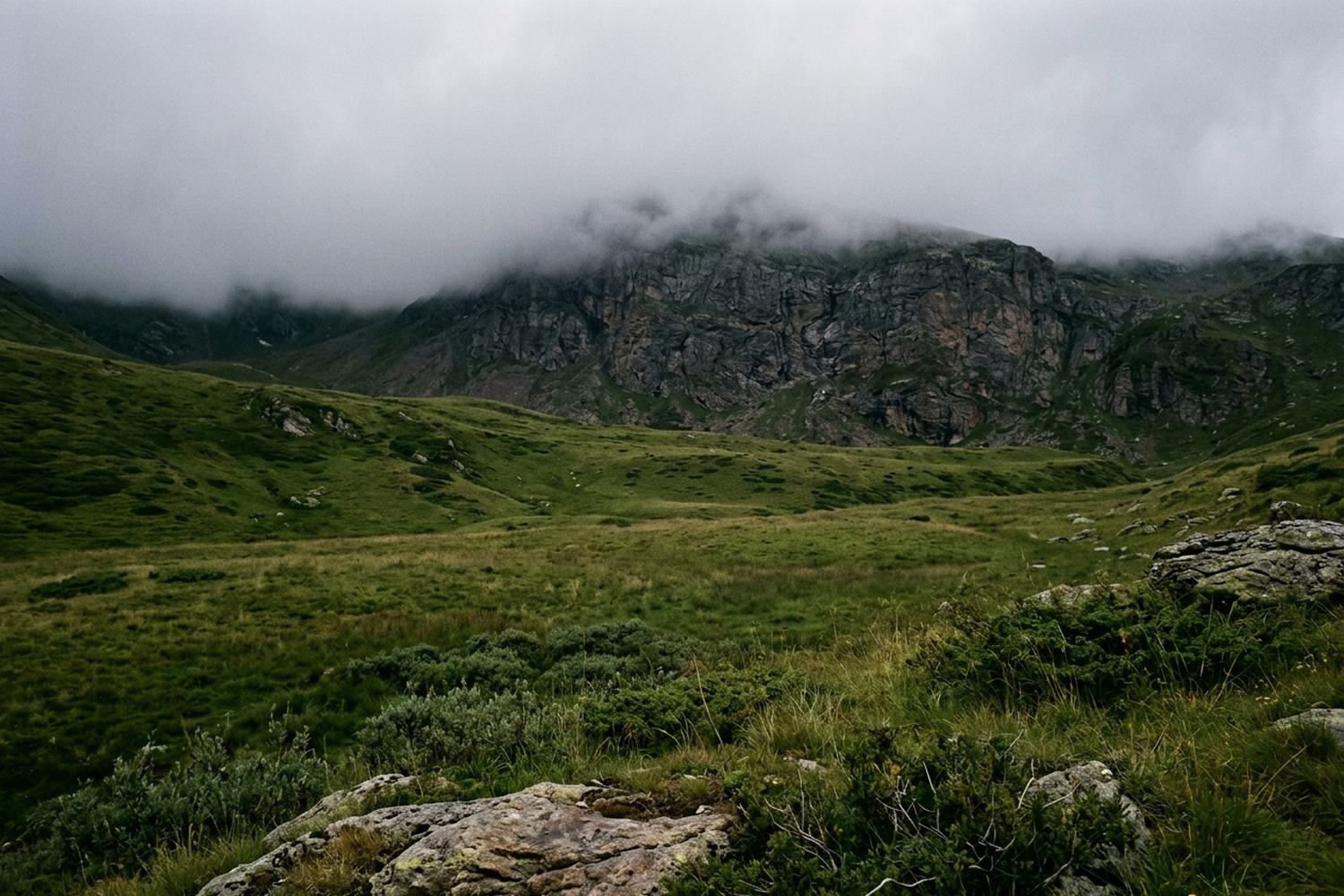
The Kackar range runs roughly east to west for about sixty miles, parallel to the coast and only about twenty miles inland from it. That closeness is the whole character of the place. Air comes off the sea, hits the north wall, and drops its water there. The northern valleys, Firtina and Hemsin, are wet cloud country at the bottom and sodden meadow higher up. The southern side, dropping toward Yusufeli, is dry, brown and steep, and the contrast across a single pass is one of the sharper transitions you will walk through anywhere.
The summer villages are built of stone footings with dark planked upper stories, and they exist because livestock come up in June and go down in September. Roofs are steep against snow. Paths between them are old stock routes, which means they are graded for animals rather than for views, and they are wet: peat, stone slabs and running water for long stretches, with several crossings that are ankle deep by afternoon and shin deep after rain. Boots come off and dry by the stove most evenings.
Weather here is not a season, it is a daily fact. Mornings above 8,000 feet are often clear until ten, cloud builds from the sea through midday, and by two or three the tops are inside it. Groups start early for that reason, not for the light. Temperatures on the pasture in August run about 68 degrees Fahrenheit by day and drop to the low 40s at night; at the pass in cloud with wind, it can sit near freezing in the middle of August.
The order the summer sells in, starting in late October
The calendar in these mountains is inverted from what most people expect. The pensions decide their opening dates in the autumn, once they know what the road is doing, and they take the following summer's names then. Not through a system: by telephone, in Turkish, in a conversation that assumes the person calling has stayed before. That is the arrangement that takes us time to fix, and it is why the deposit goes in a long way ahead of the walking.
What fills is not the whole season evenly. It is the middle of August first, then the weekend arrivals, then everything either side collapses inward.
- Late October
- pensions in the high villages open their books for the following July to September
- Late January
- the second and third weeks of August are effectively gone, domestic holiday weeks first
- Late March
- Friday and Saturday arrivals across the whole peak band close out
- Mid May
- what remains is early July, with snow possible in the passes, or mid September
- Late June
- 4x4 drivers for the Hemsin valley are committed for the summer and the support arrangement can no longer be built
- Early October
- the last pensions close and the range is shut until the following summer
Between your first message and a confirmed set of beds
We work backward from the departure you want and forward from what the villages have actually said. Nothing is described as held until a named house has said yes to named dates, and we would rather tell you in week two that your dates are gone than carry you along on a maybe. A message reaches a person the same working day. A written figure with the route, the villages and the price two to four working days go by before the figure does, because at least one of those days is spent waiting for a reply from a valley where the phone works in the evening or not at all.
- First messageyou tell us the summer you want and roughly which weeks; we tell you straight away what is realistic for that year and what already is not
- Availability runwe ask the specific pensions on your dates, in order, and confirm the guide and the vehicle days against the same window; this is the step that takes days rather than hours
- Written figureroute sheet by day with distances and ascent in feet, the villages by name, what is in the price and what is not, and the deposit that holds the beds
- Confirmationdeposit paid, beds and guide named, balance due eight weeks before departure, and the day by day sheet reissued in June once the road opening is known
Tell us which summer you are aiming at
If you are reading this in autumn you are early, which is the right time to be. If you are reading it in April for that same July, say so in the first line and we will tell you honestly what is left before you spend any more time on it.