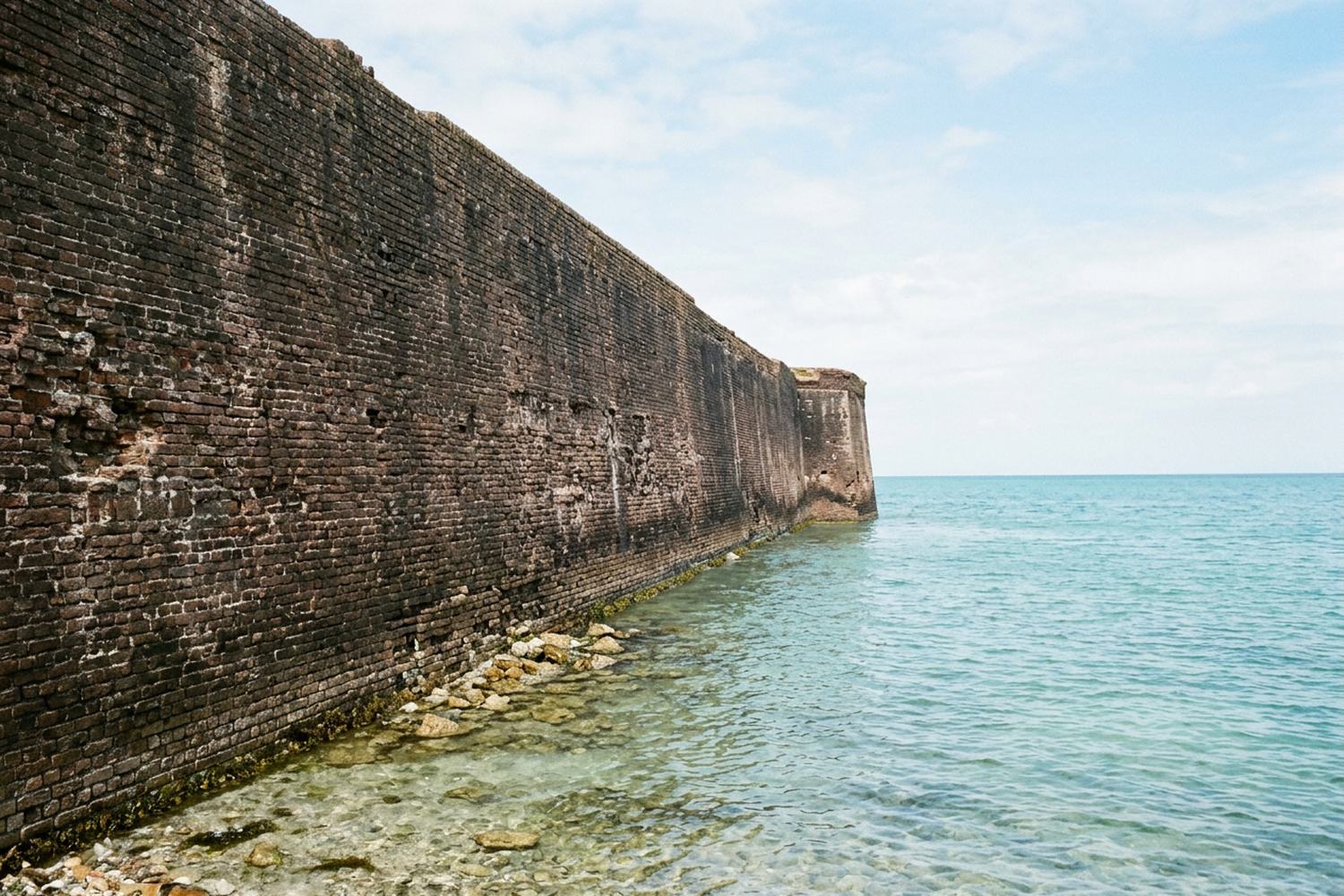
Garden Key is 70 miles west of Key West and about 37 acres of sand with a brick fort sitting on almost all of it. The fort has eight sides, walls 45 feet high and roughly 16 million bricks in them, and it was never finished. Nothing on the island sells food, water or fuel. If you reserve the Dry Tortugas two winters ahead, it is not because the fort fills up. It is because there are eight walk-in campsites and one group site, and no eleventh-hour way to make a ninth.
The crossing takes a little over two hours each way on the scheduled vessel and about forty minutes by air. Passenger numbers on the boat are fixed by the park, not by demand, and the same cap applies whether you want a day pass or a campsite. That is the whole mechanism. A single number, set decades ago, standing between a lot of people and one small island.
We sell this as six nights because a day trip is a different holiday. Four and a half hours ashore is enough to walk the parade ground and get in the water once. Two nights on the key gets you the hours before the boat arrives and the hours after it leaves, which is when the island stops being a destination and starts being a place.
- Notice
- Eighteen months or more, the book opens once
- How far ahead
- Eighteen to twenty-four months, counted backward from the day the campsite book opens rather than from your travel dates.
- What has to be reserved first
- The campsite is what sells out first, not the boat. The park releases Garden Key sites on a rolling window that opens at a set hour Eastern time roughly five months before each date, and the eight walk-in sites for prime dry-season mornings are taken within the first minute the window is live; the usable part of that release lasts seconds, not hours. Come late and what is left is day passage only, which gives you about four and a half hours ashore before the boat turns around, or seaplane seats at roughly triple the fare per head. The fallback we build for is a two-part week: day crossings from Key West on the dates we can confirm, with the camping night moved to Bahia Honda or Long Key, and a standing hold on any campsite cancellation the desk can catch.
- Nights
- 6
- From
- $3,620 per person
- Shape of it
- one ferry with a fixed cap, seventy miles out
- What is in the figure
- Six nights of lodging in Key West and, when the campsite lands, two of those nights on Garden Key; round-trip surface passage to the fort on confirmed dates; national park entry fee for every day you are in the park; freshwater and ice hauled to the key for the camping nights, since there is none on the island; mask, snorkel and fins sized before departure; ground transfer from the airport at either end; a written day-by-day plan with tide and boat times.
- What is not
- Flights to Florida; the seaplane, if you choose it over the boat or need it as a rescue for a missed sailing; any meal not eaten on the boat crossing; alcohol; camping stove fuel, which cannot be carried on the vessel and is bought locally; the second bag fee the ferry charges over its weight allowance; dive tanks, dive guiding and any boat charter beyond the scheduled crossing; gratuities; anything you buy in Key West on the four nights the itinerary leaves open; and the cost of rebooking if you change your dates after the campsite is confirmed, since campsite reservations under your name are not transferable to new dates.
- Who it does not suit
- People who cannot commit to a specific week roughly eighteen months out, because the whole trip hangs on one release date and moving it means starting over. Also anyone unwilling to carry their own gear a few hundred feet from the dock across loose sand and coral rubble, or to spend a full day on an open key where the only shade is what you brought or the fort's own casemates.
What the ground under you is actually like
Sand, coral rubble and brick. The campsites sit south of the fort on a strip of open ground with a low seawall between them and the water, and the walk from the dock is a few hundred feet on loose surface with a wheeled cooler dragging behind you. There is one composting toilet block for campers when the day visitors have gone. Fresh water: none. Every gallon you drink arrives on the boat with you, and the working figure is a gallon per person per day plus what you cook with.
The snorkeling is why the trip exists. The moat wall on the south side runs in about eight to twelve feet of water and you swim the length of it with brain coral and sea fans on the footing stones and tarpon holding station under the overhang. The north coaling dock pilings sit in fifteen to twenty feet and hold the bigger schooling fish. Visibility in the dry season commonly runs 40 to 70 feet and drops hard for a day or two after a front pushes through. Water is around 74 degrees in February and mid 80s by August.
The honest limit is heat and exposure. There is no natural shade above waist height on the whole key, the sand throws light back at you all day, and afternoon temperatures in the shoulder months sit in the high 80s with the humidity that comes with being surrounded by ocean. Campers pitch under whatever they carried. The fort's lower casemates are cool and dim and are the only real relief on the island, and they are a fifteen minute walk from the tents.
The release date is the trip, and the trip is the release date
Everything hinges on one hour. Garden Key campsites come out on a rolling window at a fixed time Eastern, roughly five months in front of each night, and the eight walk-in sites for good dry-season dates are gone in the first minute. Not the first hour. The first minute. Which is why the planning window for this trip is eighteen months and not five: we need your dates locked, your travel party fixed and your fallback agreed long before we sit at a keyboard waiting for a clock to tick over.
The ferry books on its own schedule and behaves differently. Seats for the high dry-season weeks fill six to nine months out, and the ones that go first are the sailings that let you arrive the day your campsite starts. A campsite with no matching boat is not a trip, so we solve them in that order and never the other way around.
- 24 to 18 months out
- Dates chosen, party size fixed, fallback week agreed in writing
- 12 months out
- Key West lodging held for the dry-season weeks, which fill before the ferry does
- 6 months out
- Campsite release attempted at the opening hour; result known the same day
- 5 to 4 months out
- Ferry seats for the matching sailings; the arrival-day departures are usually the first gone
- 8 weeks out
- Any remaining seats are day-trip returns only, and campsite chances are cancellation-watch
- 2 weeks out
- Water, ice and gear volume finalized against the boat's weight allowance
From your first message to a confirmed week
taken up the same working day. the costing the costing takes two to four working days on top on top, because we quote against actual availability on your dates and not against a rate card. We do not house, carry or guide anything; the fort belongs to the National Park Service, the boat and the aircraft belong to their own operators, and we hold the sequence together.
- First replyWe ask for your target week, your party size and the one thing you would not give up, then say plainly whether the campsite is realistic on those dates
- Written figureA per-person number covering lodging, park fees, passage and gear, with the seaplane priced separately so you can see what it costs
- The release hourWe attempt the campsite at the opening moment and tell you the outcome the same day, successful or not
- After confirmationBoat seats, transfers and the water and ice load are arranged against the confirmed nights, and you get a day-by-day plan with the tide and departure times
Ask before you pick a week
If you have a fixed week in mind, send it early and we will tell you honestly whether the campsite math works or whether you are looking at day crossings with nights on the Middle Keys. Either answer is worth having eighteen months out rather than five.